

Tag

b2c

Browsing

The mindset for start-ups is to keep the costs down and develop fast with quality. Therefore the idea is to have continuous improvement loops and publish the most viable product (MVP) version as soon as possible. Microsoft Azure provides services which are essential to the Software as a Service (SaaS) products. Most importantly and fortunately, most of these services have a free plan to kick start the development project. In this blog post, I’ll have a review of these free Azure essential services in SaaS architecture.

During 14 years of my career, I have worked with customers from different industry sectors and various project types. Most of them were Enterprise-grade business-to-business (b2b) solutions, and my experience with business-to.customer (b2c) products is quite narrow. As explained in my previous blog post, recent Azure certification exams are demanding, and studying requires a lot of reading and hands-on training. During my studies, the outcome product has taken my attention and interest to develop the product further. Let’s have a look at the SaaS high-level architecture in it’s purest form.
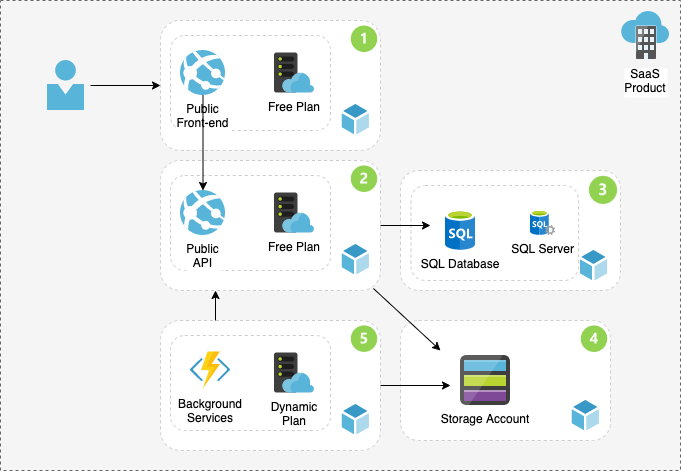
Simple SaaS Architecture

The illustration represents free azure services in Service-oriented SaaS architecture. These services are:

  1. App Service is a Platform as a Service which is the best solution to host the front-end layer and the UI of the product. Developing the UI by any best-of-breed front-end framework like Angular or React can be up and running on Azure with few clicks. The app service can be scaled as the demand grows, but you can kick start the project with the free plan.
  2. App API is based on App Service platform and will act as the service layer of the product. The API can also be developed with any popular back-end language like .net core, Node.js or Go lang. The service can be scaled up by demand, and it has many other useful features like hosting Docker containers to serve the API. The app service environment can be hosted either on Windows or Linux environment.
  3. Azure SQL is also a Platform as a service product which should not be confused with the self-hosted Microsoft SQL Server. The Azure SQL database does not require a SQL server licence, and you pay based on the Database Throughput Unit or DTU. Developers can have SQL relational database so serve the API layer. The Azure SQL does not have a free tire, but the Basic tire with 5 DTU costs under five euro per month.
  4. The Storage Account is a package of four different services, and you pay only for the use. The following services are essential for the SaaS product:
    • Blob Storage is the solution to host images, videos and binary files.
    • Table Storage is the part of the storage account to host non-relational data in a table format where the schema can scale based on needs.
    • Storage Queue is a simple service bus solution to enable event-based operations.
  5. Azure functions are server-less PaaS product which is hosted on the App Services environment and is a perfect solution for handling the background processes. To read more about Azure Functions in cation and hosting plans, please refer to my previous blog posts.

The services above are the perfect initial parts of a SaaS application. The architecture can be extended with other services to provide an industry lead solution which can be topics for my next blog posts.

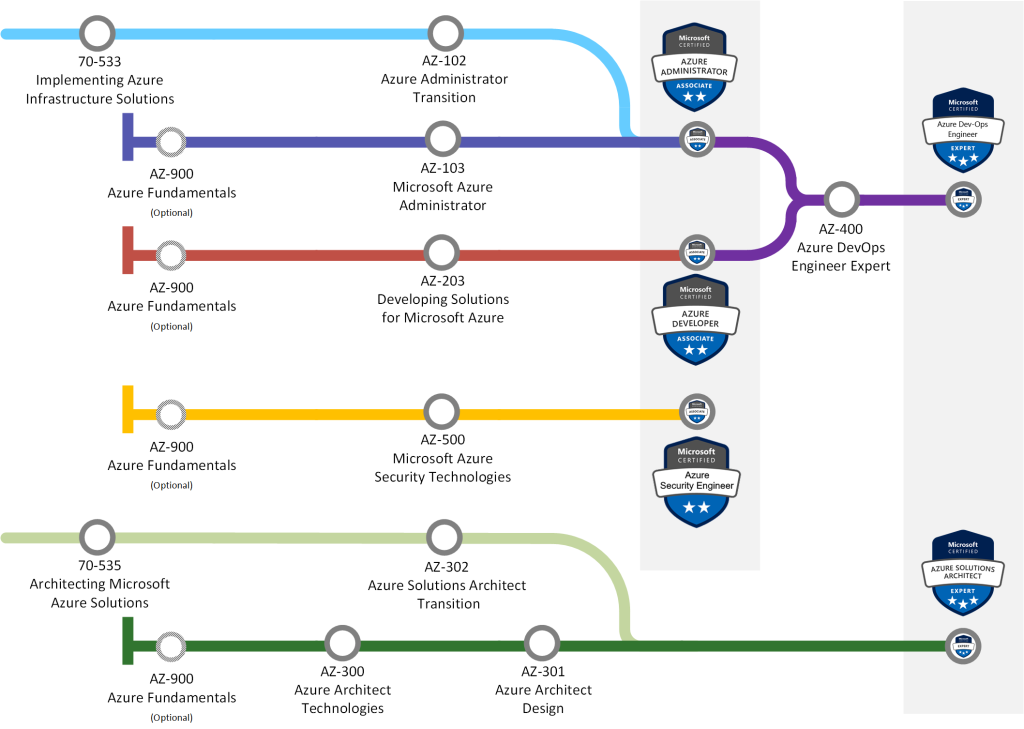
The latest Azure certification exams are demanding and need a lot of demos and hands-on training. During the preparations and experiments, an e-commerce Azure Saas Platform was formed unintentionally.

Taking Microsoft certification exams has been apart of my professional career since 2007. Certifying myself not only verifies the current level of my knowledge but also makes me study hard for newly available technology. I’m currently on the DevOps journey with the following exams:

Azure certification paths to create a SaaS product
Azure certification paths in 2019

Experiments turned to a SaaS platform

There are many guides and blog posts on how to study for exams and what materials to read. I find it best to read Microsoft documentation, create demos and have experiments. During the study period, my demos and architectural decisions became a fully functioning Azure SaaS platform. I’m still on the study path, so there is a room for upgrades and changes in the architectural decisions.

The demo I have created is an e-Commerce solution using Azure products and services, which are a part of measured skills in exams. To improve processes and add an extra layer to the intelligence of the application, Microsoft provides AI tools part of Microsoft Cognitive Services which I plan to include in the platform. The trial by applying AI services provided by Microsoft will also indicate the maturity of these services and a way to observe how enterprise solution-ready they are.

I have kept the Start-up mentality in mind by minimizing the costs of services on Azure as much as possible. The plan is also to include cost calculations about used services in my upcoming posts. The DevOps methodologies and tools will also be an active part of the process. DevOps helps to keep everything as simple as possible and automate the most processes as possible.

The SaaS platform is currently running on https://obrame.azurewebsites.net. “Obra” means “work” in Spanish, which is the current language of the service.

Upcoming blog posts will explain the processes of the SaaS solution. The posts will also go through important Azure services and their role in the technical implementation. The next blog post will explore the high-level architecture and initial services used to run the application in the Microsoft cloud.

Recently, I attended a conference at Metropolia University of Applied Science as a co-speaker with my dear friend and workmate Jouko Nyholm. We attended to present about “Enterprise IT and Microsoft Solutions”. Attendees were a group of final year students from the Information Technology and Media engineering course. I spoke about entrepreneurship and during the questions and answer part, a student raised a funny question. The question was “So what is the next good idea to create a new start-up?”. My answer included giving the student advice to read the first part of “An Excellent Idea For a Start-Up (Part 1)” and wait for this blog post. If you haven’t read the first part of my blog post about the perfect idea, I recommend reading it first before continuing with this subsequent post.

Most successful Enterprises are mission oriented. It is extremely hard to gather a large group of people together and have their focus set to produce maximum productivity the company needs to perform an important and successful mission. It is almost impossible to succeed without a good founding idea. If the group does not feel the passion and love for what they are developing, they give up at a certain point in time. There is no way to keep the group together and execute the given mission, specially during the difficult times. Most young founders specially students think that the start-up phase will take a few years and maybe after that phase, the group would feel passionate about the idea. However  as I explained before the start-up will take 5-10 years to succeed.

One of the biggest mistakes is to copy an idea with small new insights. The act of copying does not excite people at all and it will not make the team work hard enough to be successful. The puzzle of creating a new idea is the problem that most founders face.

The fact is that the more you practice, the better you become and it is effectively worth trying to get more innovative and productive with the puzzle. The strange part of creating a greater idea is that, the best ideas look terrible at the beginning.

In my case, creating a company with small resources and no enterprise references sounded ridiculous. To be honest no Chief Information Officer (CIO) wanted a garage start-up as an enterprise service provider. The idea of creating a new cloud service provider sounded odd at the beginning because of the lack of trust and market size at that moment but it turned out to be a really good idea as the enterprise cloud transformation started to grow.

The idea to provide the same service as other competitors with the same project model and quality would have been insane and would have never took-off.  Entrepreneurs should look for a small market to gain a large part of it and expand the business fast. You should say to yourself; today only a small group of users or companies will use my products or services, but in the future, most of decision-makers will demands to use our services or products.

The entrepreneurs should keep in mind that if they come with a great idea it is possible that most people will keep it as a bad idea. You should not grieve but instead feel happy about it. This is the reason it is not dangerous always to tell others about the idea. Keep also in mind that the bad idea does not sound to be worth to be stolen. Basically, what is needed is an idea that many people are not working on it and it is more than okay that it doesn’t sound big at the beginning. The common mistake amongst young entrepreneurs is that they think the idea they have should sound or be big.

Here comes the secret of perfect idea: after figuring out a new idea, you should evaluate the market. What is needed is a market that is going to be big in 10 years. Most of the people are only interested in the market size existant today and they don’t think at all how the market is going to evolve. The mentioned mistake is not only amongst founders but also among the investors too. Some investors care about the current size of the start-up and not the size of the market in the near feature. In the small markets which expands fast, customers are looking desperately for a solution and have the will to pay for the cure you have for their needs. The important fact is that you cannot create a market which does not want to exist. You can change almost everything from the start-up but not the market. You should make sure and double check that the market you are looking for exists and will likely grow. The fast growing of the market is the most important thing!

Let’s wrap up the blog post:

  • Your mission is important to motivate people in the start-up and increase the productivity
  • A bad idea is always bad and will not change the way people think about it and will get worse during the difficult times
  • Copying an idea with no new insight is wasting time of the whole start-up
  • The more you practice developing ideas, the better you will get, so keep trying!
  • The idea doesn’t have to sound amazing and big at the beginning
  • Share your ideas with others and don’t be scared
  • The market is the most important thing with the new idea
  • Choose a market which exists, and will grow fast
  • You can change everything in your start-up but not the market

It has been a while since my last blog post, but in IT business a lot happens at beginning of the year which has kept me particularly busy. I would like to dedicate my next two posts to the subject of an “Idea” and the importance of the idea behind start-ups.

Whilst acting as an entrepreneur, I have engaged in constructive discussions with young entrepreneurs and some students who are planning their own start-ups. In most cases, I felt that young entrepreneurs do not focus on the idea or about the importance of the idea. This causes them to ignore the time they should spend to think and evaluate the value of the product or service they plan to deliver.

I found that these sorts of people tend to rush the start-up and gain success in a silver plate. Rushing to start-up may not be a bad idea, because things evolve and the world changes continuously, and in all honesty a good execution has extremely more value than a good idea. However, I believe it is clear that a bad idea is still a bad idea. Even the greatest execution will not get start-ups anywhere. Nonetheless, there are some minimal exceptions, but most successful companies have initially started up with a good “Idea”.

So, what can the Idea be described as and is it only reflective of the product or the service that one wishes to start-up?

In fact, most people seem to think that the idea is derived from being able to answer: “What do we want to provide to the customer”.  However, the definition of an idea is much wider than answering these sorts of questions. The definition of an idea includes the size and growth of the market, the growth strategy for the company and the defence strategy of the company against competitors.

During the idea evaluation, the founder should go through all facts and evaluate the quality of the chosen idea. As mentioned in my previous posts, it takes at least 10 years to shape a successful company. Therefore, it is really worth sitting back and taking enough time to think about the long term goals in order to add value to the business. This would then allow you to build on defending the business at depression. It is almost impossible to plan everything in advance and the start-up should be as agile as possible, and planning beforehand may become worthless at some point, but the practice of the planning has a grand value for the future. In most start-ups there is a lack of long term panning but if you have it, you will possess great advantages in the future.

The idea of my start-up currently known as Digital Illustrated was born during my last year as an employee. I was unsatisfied with the way the company was lead and the strategy in which the projects were managed. Repeated management errors occurred during my career and at the same time, the IT business was transforming.

Moreover, the term “cloud computing” was still unknown to most people and Microsoft lunched the first version of Office 365 (known as BPOS back then). Therefore the Idea I came up with was: Create an agile company in Microsoft’s ecosystem and go “Cloud”. The defence strategy was to generate and provide services with extremely high quality that makes end users and employees extremely satisfied. The idea was not the most unique one, but this was a new born market on its way and a gap to for us to fill. I intend to go into further detail about the relationship between the “market” and the “idea” in the second part of my blog post.

To wrap-up the first blog post about how to have a new idea for a start-up, here are some issues I advise you to keep in mind:

  • The idea always expands and you will become more ambitious as the journey of your start-up goes on,
  • You don’t need to plan everything from A-Z, but it is good to have a plan to start with,
  • The idea should always come first and then you should go for the start-up,
  • You should wait until you have the perfect “idea”. It is important as you should aim to choose between good and bad ideas;
  • If you have multiple good ideas and you want to choose the best one, take the one which you have mostly in mind during your free time (most of the founders regret the fact that they started the company without the idea they loved).